Monday, 21 November 2011

Day 8 - Rest and Recreation.

Firstly today - here is a group photo of this year's team at the stationary carriages on the Hijaz railway at Bir Shedia.


Today was our first rest day. After many days of hard work in the desert, the team took the opportunity to spend some time visiting local places of interest. 21 of us went into Petra, some for the first time and others coming back for a repeat visit. Others went off to view some Copper mines about an hour and a half's drive away, whilst some of the core team visited Mudawwara. Pictures speak louder than words on today's blog, so here is a selection of images taken at various places. More will be added later.
First view of The Treasury from The Siq


Large (10 cm) insect on the steps up to the Monastery in Petra


The Monastery


Copper mine

Sunday, 20 November 2011

Day 7 - A steam engine and some 'ornamental' forts.


On the way to today’s dig site we stopped and spent a few minutes looking at a 1959 steam train and carriages used as a tourist train for the Hejaz railway. Halted in a siding on the line, it was quickly covered in GARP 2011 members, with many taking the opportunity to take atmospheric photos. We also took this year’s group photograph which will be posted on the blog soon.


Next we went to begin investigations of two small structures which we have been describing as ornamental forts, largely because some of the features they exhibit seem inappropriate for defence or construction purposes. One of these, which we are calling the round fort, was planned by a small team while the other square fort, which is known as Saleh’s, was also planned while the rest of the group excavated a series of nearby, relatively indistinct, tent rings. This is definitely a work in progress and we are still thinking about how these features fit with the others we have examined in the region.


Now to the next in our series of pen-portraits of group members this season. Here is a contribution from John Raiswell, who is actually making his second visit with us.

“My second season with GARP! My first in 2007 marked the start of a new interest in archaeology, I made new friends and enjoyed both the work and the location very much. So I’m back.

John Raiswell planning an excavated tent ring in Southern Jordan


In preparation for the season I’ve read many of the published papers and I’m impressed with our level of knowledge of the conflict around the Hijaz railway. I particularly liked the paper by Shaqiarat al Salameen, Faulkner and Saunders which showed the nature of the interactions between the conflict and the environment of the Hijaz. Arriving at Wadi Musa, it was a real pleasure to meet old friends from the core team and the volunteers and I’m enjoying getting to know the volunteers I haven’t met before. One big change from 2007 – the majority of volunteers are not from the UK.

When we’d recovered from jet lag over the following couple of days we had an excellent orientation lecture from Nick and later a tour around Ma’an station and the Hill of the Birds. But what a disappointment to see how the trenches at the Hill of the Birds have been destroyed, or at least allowed to decay. I understand the site is to be built up as a tourist destination – it’s to be hoped the Jordanian  authorities can be persuaded to protect this important site.

We began work last Thursday at Ghadir el Haj station. When we arrived it was literally a pile of rubble – the result of a bomb attack by Lawrence. We worked steadily throughout the day and at the end had done, I believe, an excellent job of clearing and revealing the structure. Very satisfying.

Arriving back at the hotel, the core team set to work recording the events of the day, cataloguing finds, photographs and writing reports. All of this done on laptops in the hotel foyer – a huge change from 2007 when I believe the team had only one laptop. Very professional. I was also impressed at how swiftly the team responded to John Winterburn’s revelations about the fortifications around the ‘ornamental’ forts. We spent today (Sunday) in a previously unplanned investigation in the area.

Today we are about half way into the season and I am hoping very much that will be able to get permission to investigate the conflict around the road to Aqaba. This should provide a really interesting contrast with our work around the Hijaz  railway – the contrast between guerrilla warfare and more conventional battles. I hope also we can start work on some of the oral histories planned. These should compliment and flesh out the site work and contribute significantly to our overall understanding of the war in the desert.

Meantime it’s off to the bar for a can of Petra ale and scintillating conversation! Some things never change!”

Many thanks to John for his comments. Tomorrow is a rest day and many of us are visiting Petra. Pictures and a report will be posted later in the day.

Saturday, 19 November 2011

Day 6 - Bird’s Nest camp site – Second day


So – why did we go to the Bird’s Nest camp at all? How does it fit in with the rest of the project?  The idea of targeting these tent rings rather than any number of others that we know about, is their proximity to a theoretical quarry, and because we have never previously targeted a tent encampment associated with activities other than forward defence, or in association with the railway. In overall context, this is only the second site that we have examined away from a structure. The tent encampment here was located to the west of the modern Hijaz railway line on flat, open ground. The site is composed of 27 tent rings in two distinct rows, with a separate tent ring located to the south west. The rings vary in size from approximately 450 - 530 cm in diameter and, unlike previous sites excavated by the team these appeared to be more fully constructed, showing in places two courses of layered angular stones. Entrances could be observed in a number of tent rings, but not all. Interestingly, three of them were out of pattern with the remaining rings, which might suggest different use.


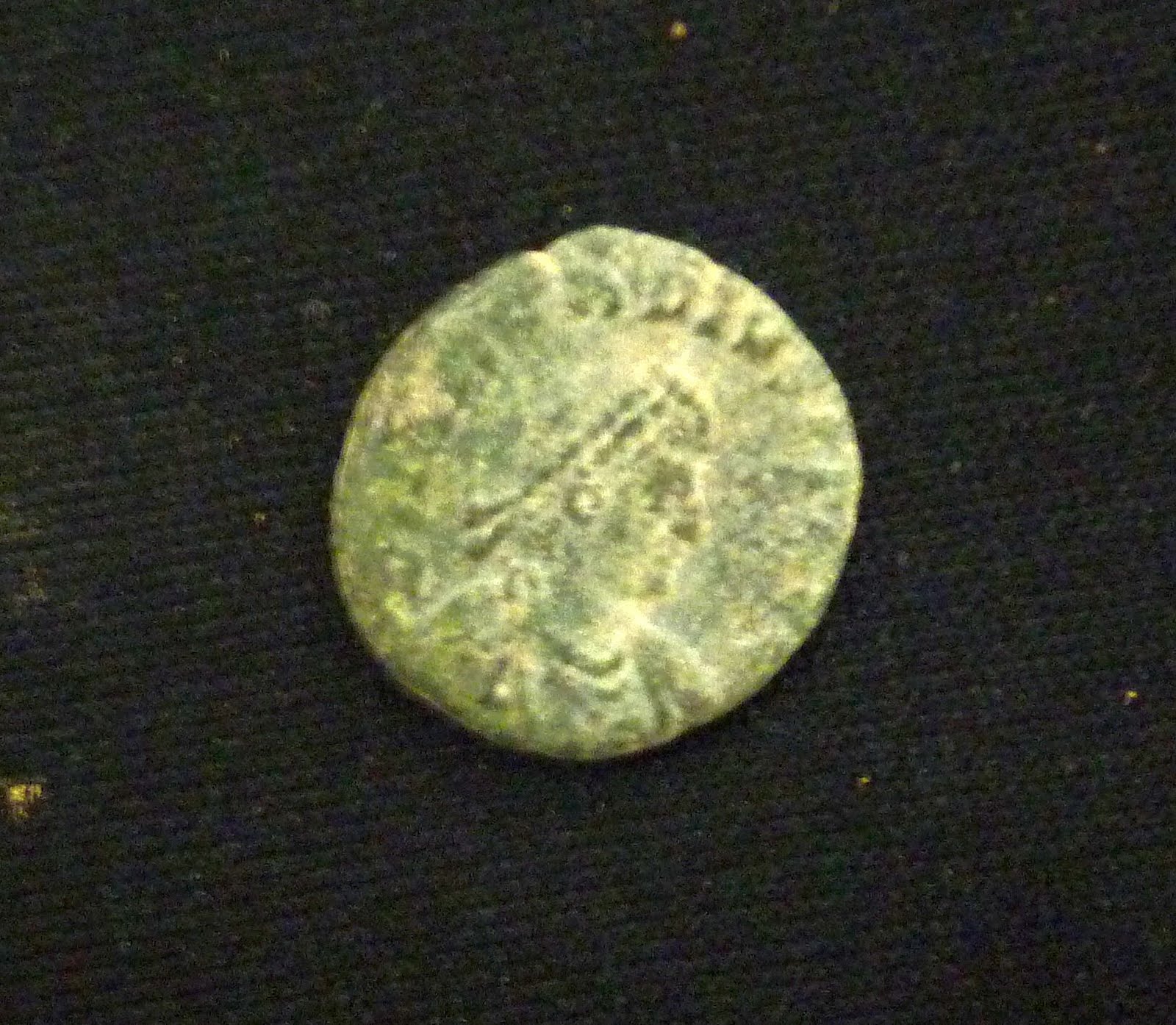
Over the two days, the investigation of the rings involved hand excavation in groups of three, the teams often comprising returning, experienced diggers and new members. Hand sieving of the removed fill revealed a mixture of finds including a spoon with star and crescent symbols and Arabic script, Ottoman buttons and buckles, cement bag tags, and surprisingly, a Roman coin.


Following the excavation and the reporting, a full planned record of each excavated ring was completed by the team which undertook the excavation. This involved the careful measurement and scale detailed drawing of the individual stones forming the ring. The completion of the recording was achieved by a full photographic survey of each ring, and the site, and a metal detecting survey of the rings and the spoil heaps.

The excavation here successfully established an Ottoman presence through the collection of finds solely attributable to the period of and around the Great Arab Revolt. No direct link was established between the camp and the quarry, although the sturdy construction of the rings may suggest a correlation. 

The excavation and recording here adds another fascinating piece of the enfolding jigsaw of investigated sites related to the activities associated with our study of the Great Arab Revolt, providing ever more clues towards better understanding of this conflict.

Friday, 18 November 2011

Day 5 - Bird’s nest camp site – first day


Today we moved to a new large site consisting of 26 well established tent rings on a flat plain near the railway, about twenty minutes drive south of where we had been working yesterday. We plan to investigate this site for a couple of days, so this will be an introduction to it and more information and pictures will follow tomorrow.

Team working on the rings at Bird's Nest camp


The evidence of two long parallel lines of tents remained by virtue of the stones that had been used to hold down the canvas at their perimeters. The group was split into 7 teams and each team was allocated a ring to excavate. Over the course of the day the painstaking removal of layers of sand and stones began to reveal characteristic finds in some, giving an insight into their occupants.


Personal seal and ring


Some of the finds today were really interesting – an intact Ottoman army officer’s personal seal, an ornate but damaged ring and several French cement bag tags. We are hoping to be able to trace the person who owned the dated seal and maybe something about them. If we do we will report our findings here on the blog next week. It’s always amazing to be able to link a personal find to a real individual, so we are hoping for success.

The work at this site continues tomorrow, so there will be another report from the Bird’s Nest camp then, together with a lot more photographs of the tam in action and the location itself.

Now for a new feature for the blog. We will be asking some of the volunteers and other team members to paint a pen picture of their reasons for coming on the Project, and how they are finding it out here working in Jordan with us. We begin with Alistair MacLellan, who writes....

“I just came across GARP in Summer 2010 whilst I was job hunting. I had recently graduated with a postgraduate diploma in Arabic language, so as well as the usual London based jobs I was looking further afield to places like Jordan and Egypt to see if there was something more exotic to fill  my time. However I found a job sooner than expected and had to delay joining the project until the current season.

I was not sure what to expect when joining the project.  It is well established – this is it’s sixth season – and what experience I have dated back to my undergraduate degree in 2007. I came to the project blind, not knowing anyone. However the first three days have been spent settling in, including some sight seeing and a day of induction, which has meant I am able to put names to faces.

It is a tight knit project, with any of the guys and girls having been here for previous seasons. Having said that there are many of us – say 40% - new to the project. We are also quite a varied bunch from all over the world. The mix of age, experience and professional background makes some quite effective teams in the field.

I did think we would be doing a lot more field survey. However a lot of research has clearly gone into the fortnight we spend here which has meant we have been able to actually excavate at two sites in two days. I was worried that my lack of practical experience would show but the project leaders were not lying when they said that volunteers of all ages and levels of experiences are welcome here. The site supervisors are relaxed and happy to offer help and advice – but I have noticed that we are allowed to use our own initiative and approach our certain area of the site in whatever way we think best.

My favourite aspect of the day so far is how it has encouraged me to think about the landscape. Most travellers, like T.E. Lawrence, Charles Doughty or William Palgrave put a lot of effort into describing the landscape we currently work in, but to be here and to see it for myself gives a massive insight and sense of appreciation of the challenge faced both by the Arabs and the Ottoman troops defending the railway. When we were excavating the demolished station at Ghadir el Haj it was easy to imagine the small garrison having to rush out into their shallow trenches as the Arabs rushed out of the flat, featureless desert.

Alistair with the Mauser cartridge he found in the station at Ghadir el Haj


But the main point I would like to make is that, even as we as a project focus on quite a narrow period of time – 1916-1918 – we come across, at every turn, evidence of a landscape affected by human activity. The seventeenth century fort at Unayza. Built to defend the Haj route, in the 20th century it was fortified to defend the railway which it overlooks. The chief engineer’s house at Ma’an is now a museum celebrating Jordanian nationalism. The modern day Jordanian army used the rock cut trenches above Unayza for their military exercises. Villagers dig for rumoured gold and dump their household waste in the trenches above Ma’an. Bedouin use the tent circles at the Bird’s Nest site to shelter their livestock.

Basically the landscape and heritage of the Hijaz railway is not something passive sat out in the desert as I must admit I found it easy to regard it , reading Seven Pillars back in the UK.

It means different things – and is used in different ways – by many groups of people of whom the volunteers on the project are just one. It is really great to be here – just a few days in and the work done here has reminded me how engaging archaeology can be. Well recommended